AITOR ORTIZ

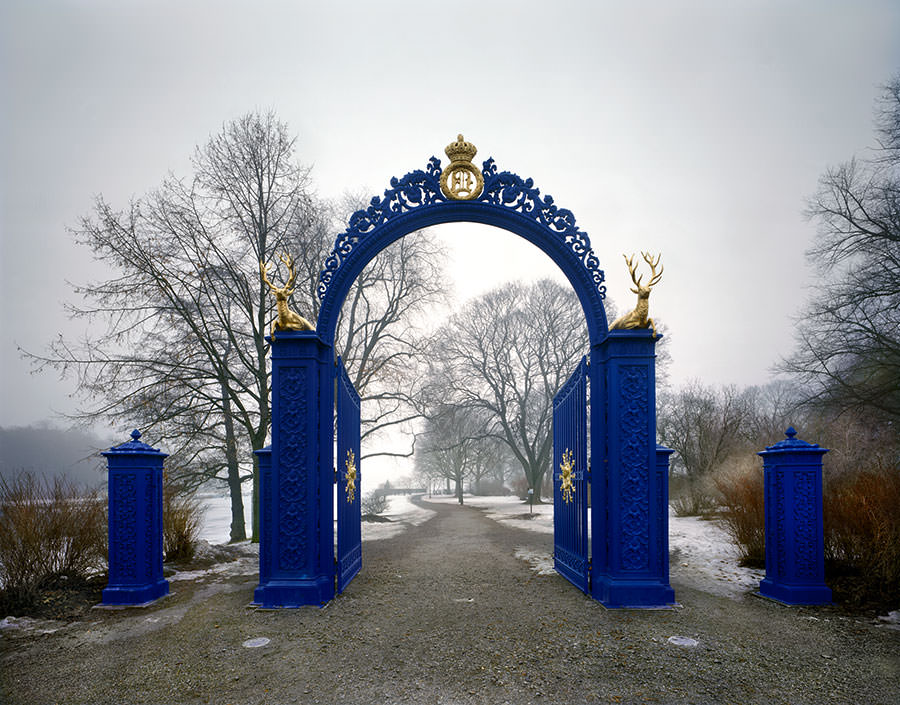
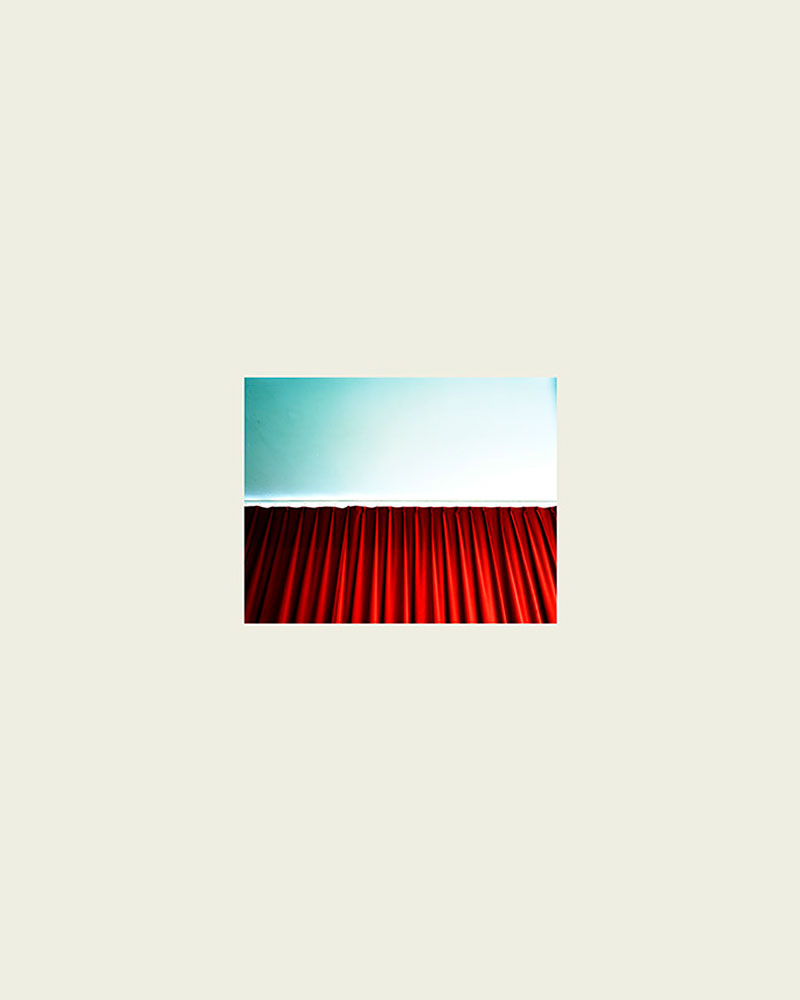
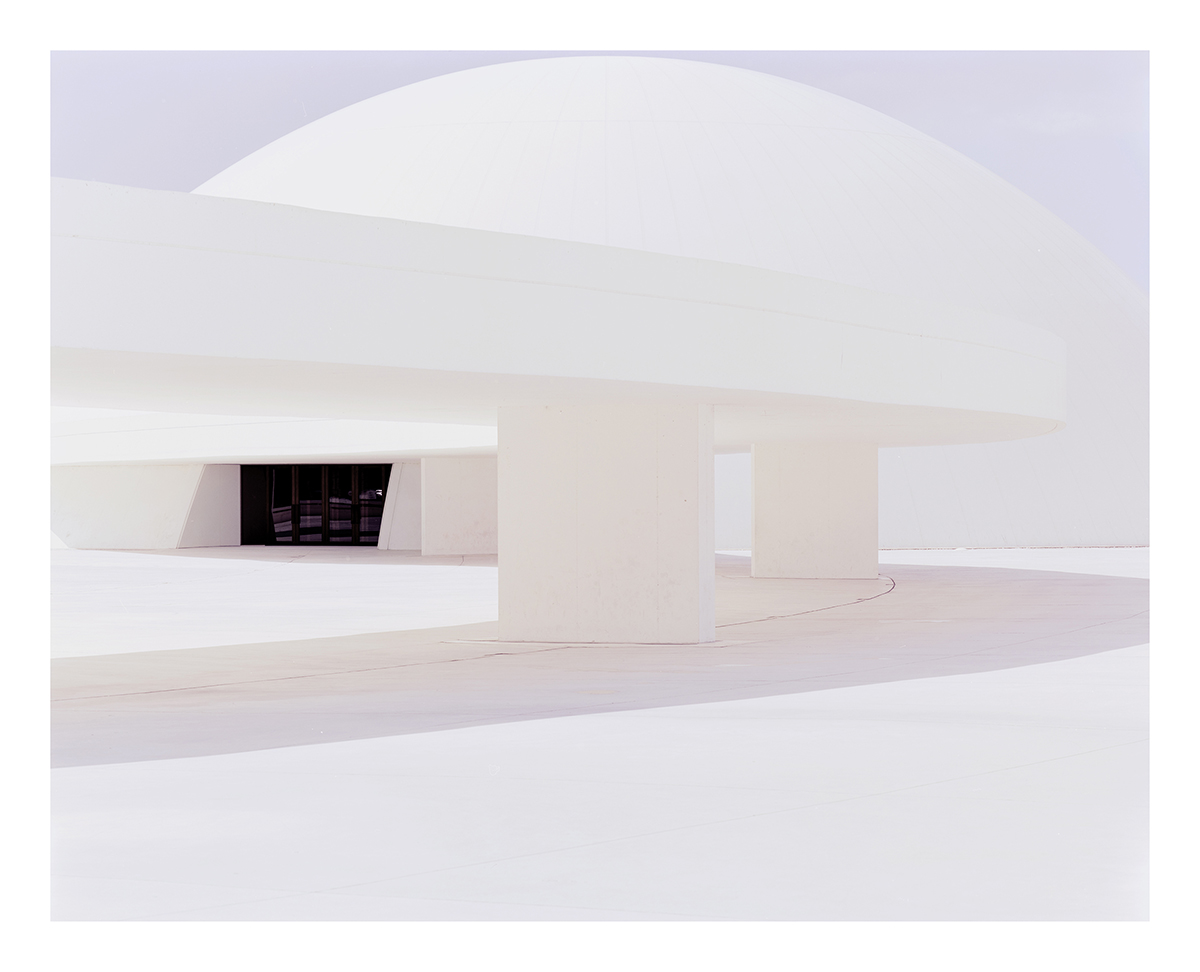
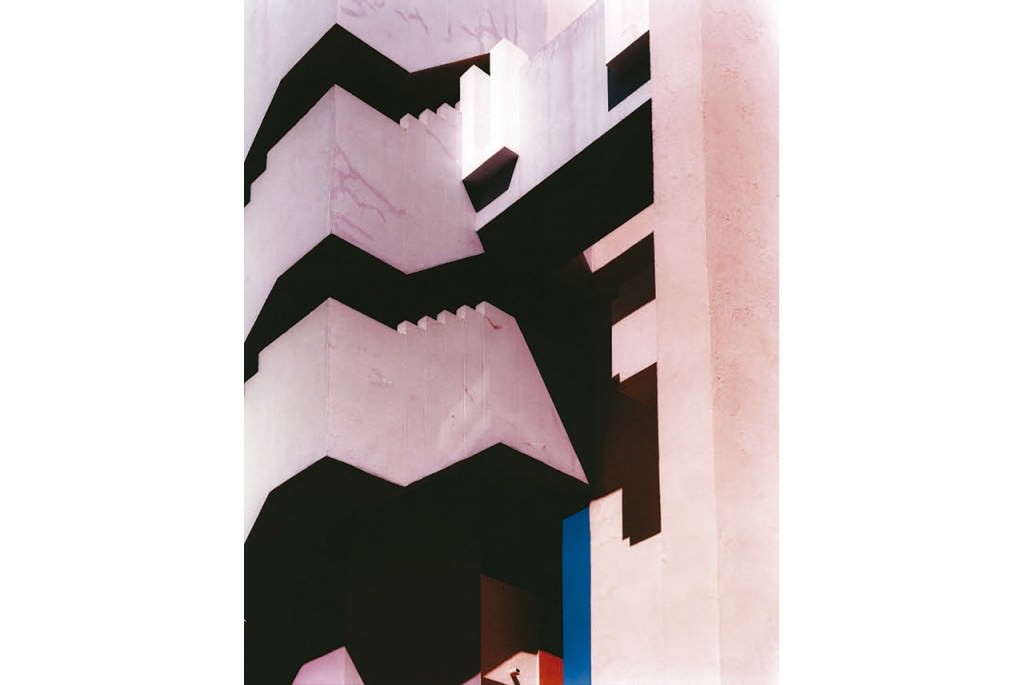
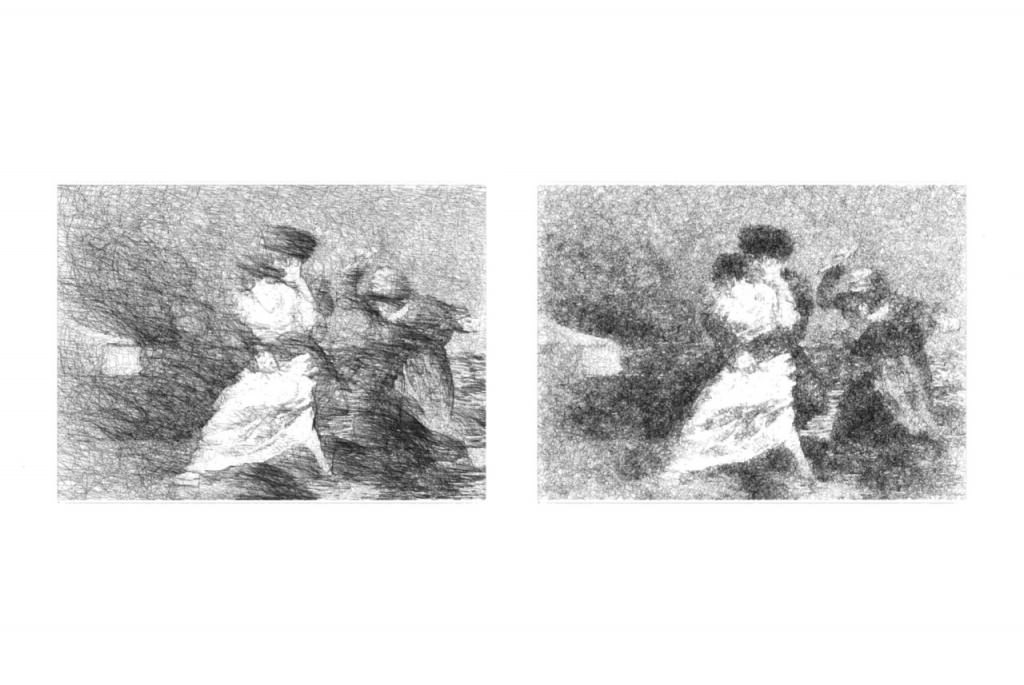
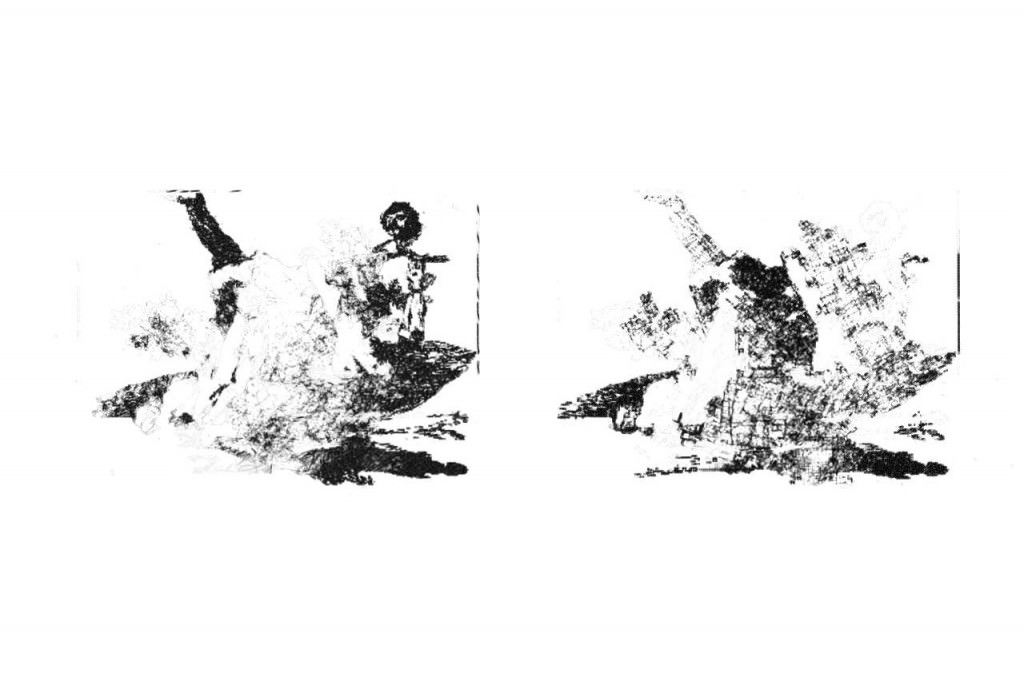
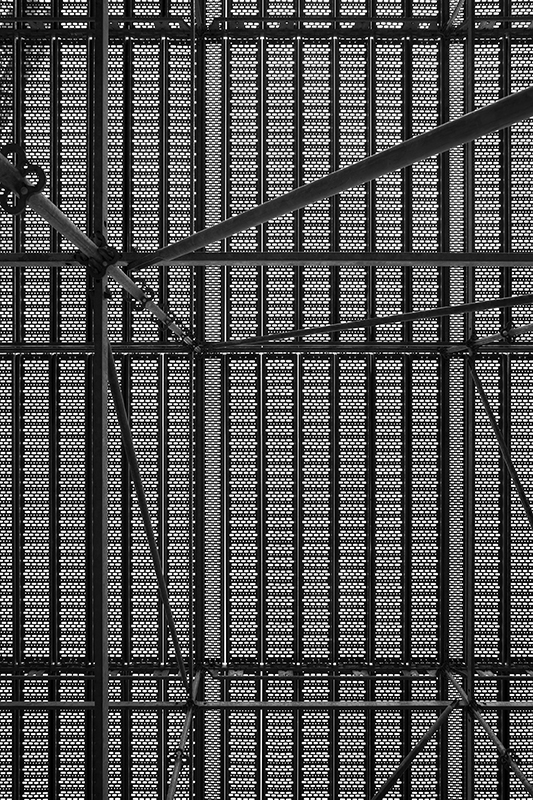
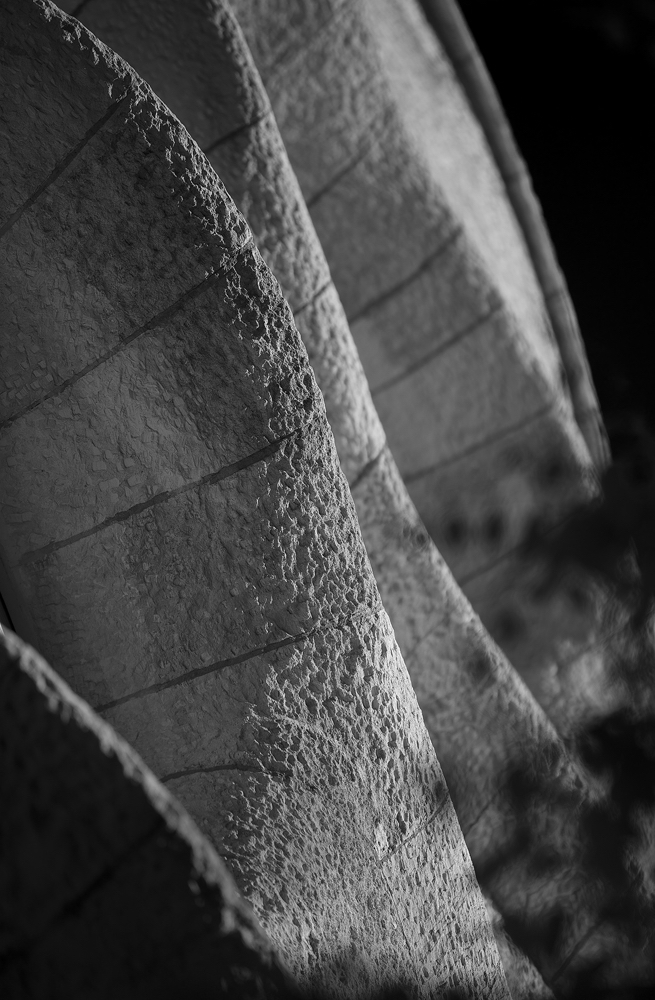
Aitor Ortiz  has developed a solid artistic career disputing the limits of architectural photography. The representation of the building is not seen from a documentary point of view instead refers the image to meta-photographic issues linked to the execution of the photograph or the formal possibilities of the representation itself. With this approach, his work has been extended into a more expanded field that includes the process of construction and perception of the image.

In front of his work, the viewer faces naked architectural constructions where there are no human tracks or elements that serve to contextualize these buildings. The reduction to structures without stylistic references creates doubt if the building is in the construction or degradation phase. This extirpation of all accessory causes the compositions to have a marked geometric character that enhances the structural component of the buildings, attending to their regularity and symmetry. Architecture abandons its third dimension in this way and becomes a two-dimensional and abstract representation that emphasizes its monumental aspect.

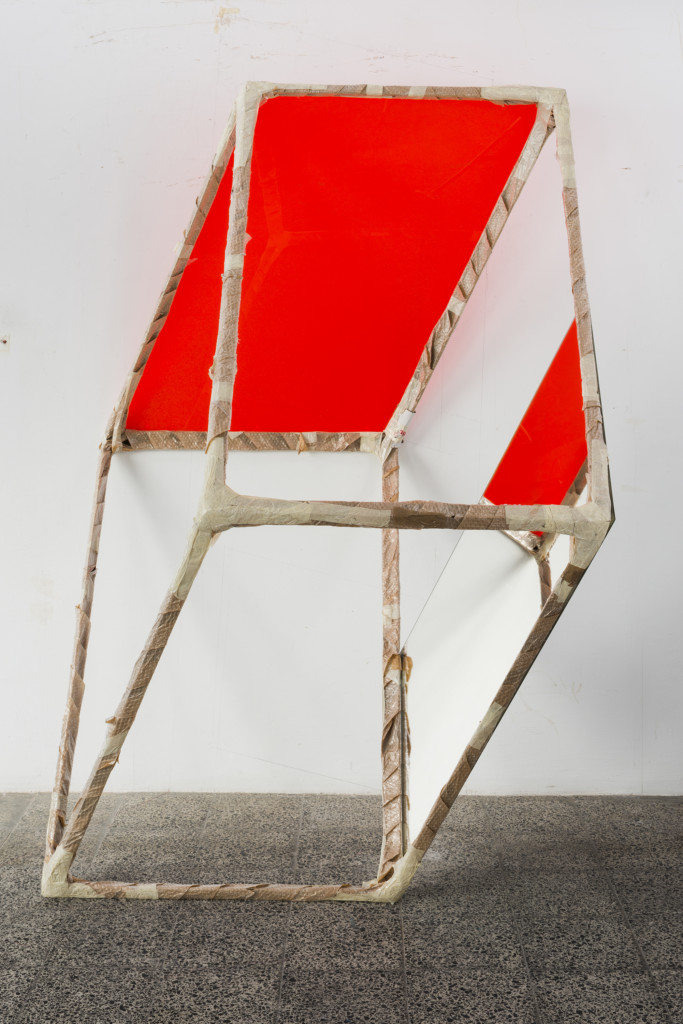
Aitor Ortiz also presents an evolution of his work through the combination of artistic languages. The artist does not consider artistic techniques as closed systems, but preliminary mechanisms of creation.We find three-dimensional sculptures made with photographic surfaces in which the author transgresses the traditional categories and extends his experience beyond the limits of the language of photography. This hybridization endows his research with the nature and autonomy of photography of a dialectical process that questions and modifies its own terms. This hybridization endows his research with the nature and autonomy of photography of a dialectical process that questions and modifies its own terms.
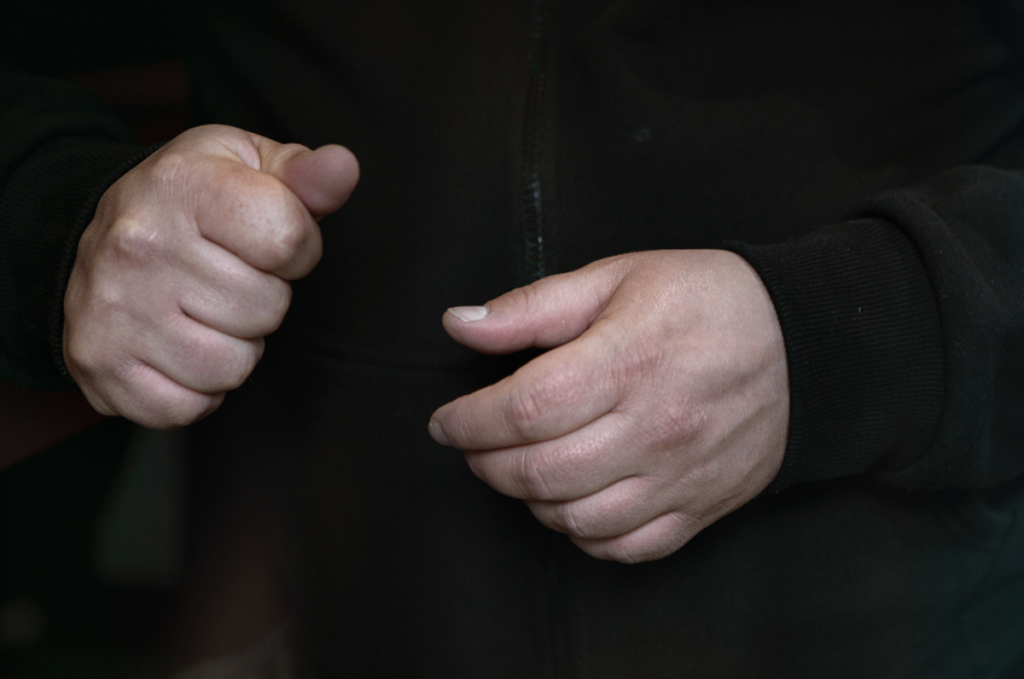
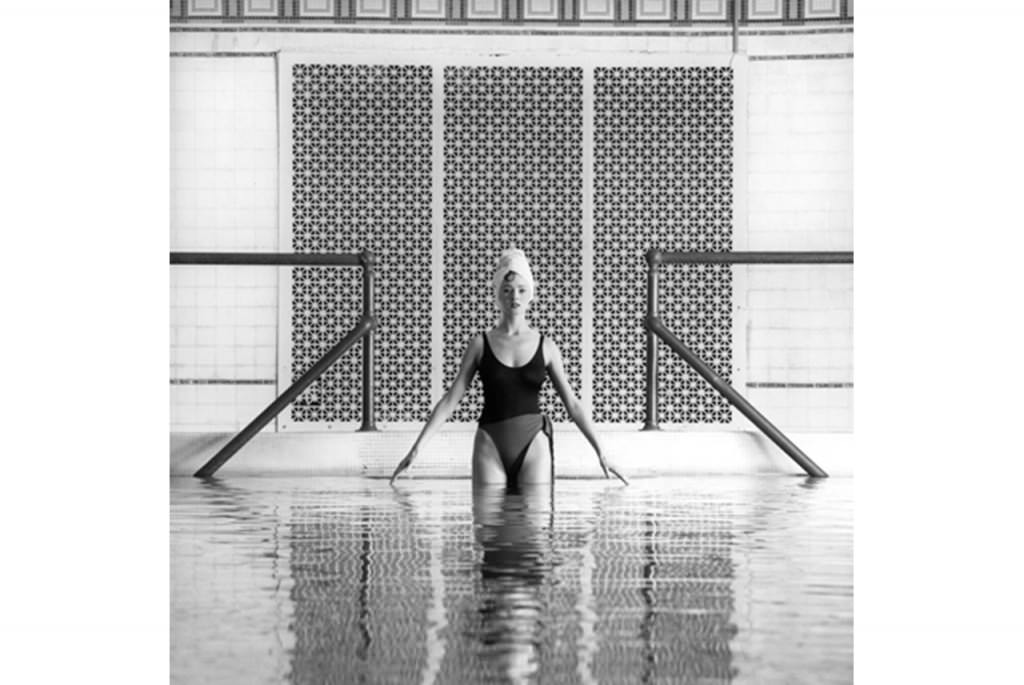
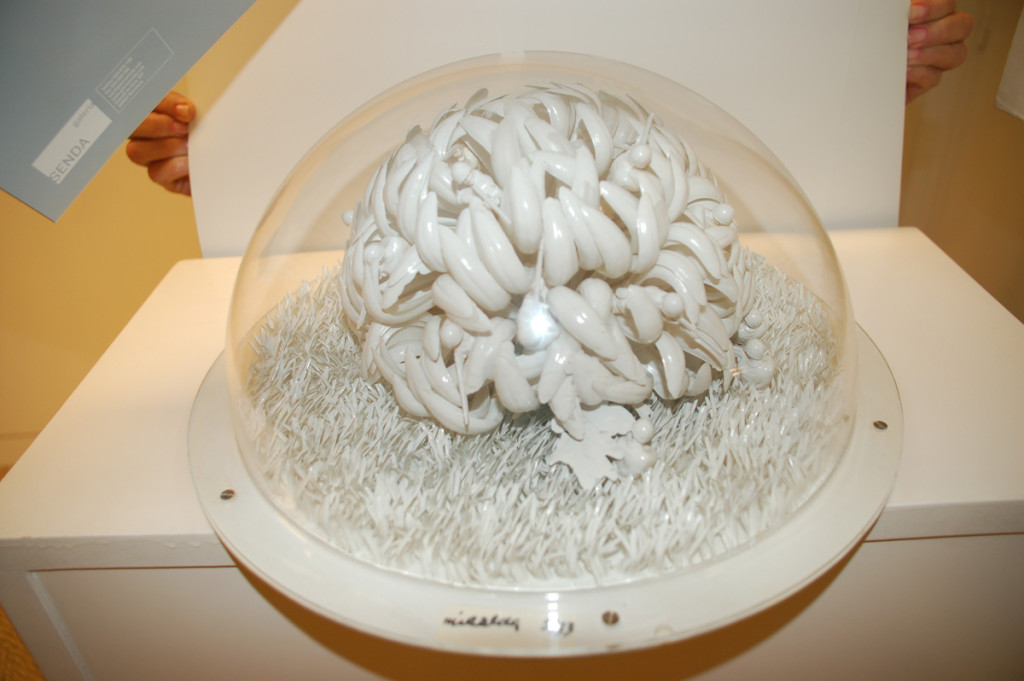
On the other hand, the photographs of the Amorfosis series arise from a concrete event that conditions architecture and reveals hidden structural elements or a certain constructive moment, such as a fire for example. Aitor Ortiz records this documentary information in order to reconstruct it later and dissociate it from its imminent obsolescence. This is how the constructive element itself comes into confrontation, the reconfiguration the viewer makes of photography with the tensions between the object of new construction and what the image shows.

Art Brussels 2019

Galeria Senda will participate in Art Brussels 2019,  in the main session, we will be presenting new pieces by our artists  AES+F, Stephan Balkenhol, José Pedro Croft, Peter Halley, Yago Hortal, Catalina Jaramillo, Ola Kolehmainen, Glenda León, Túlio Pinto, Alexis Rockman, Gino Rubert and Sandra Vásquez de la Horra.

GINO RUBERT, The place to be or not to be

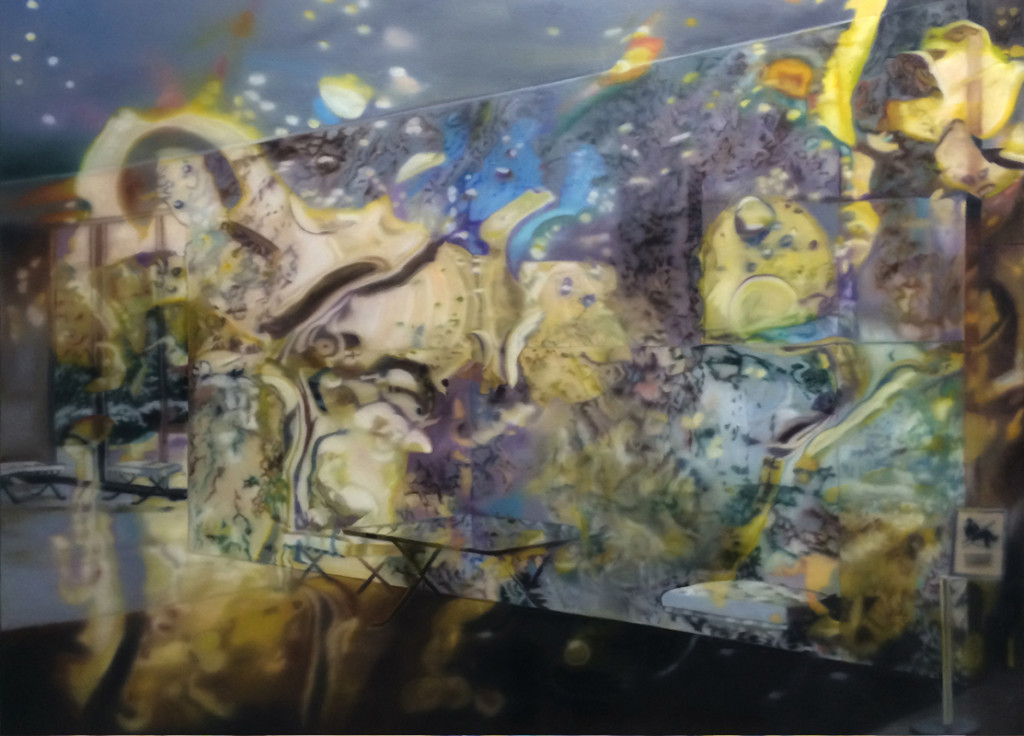
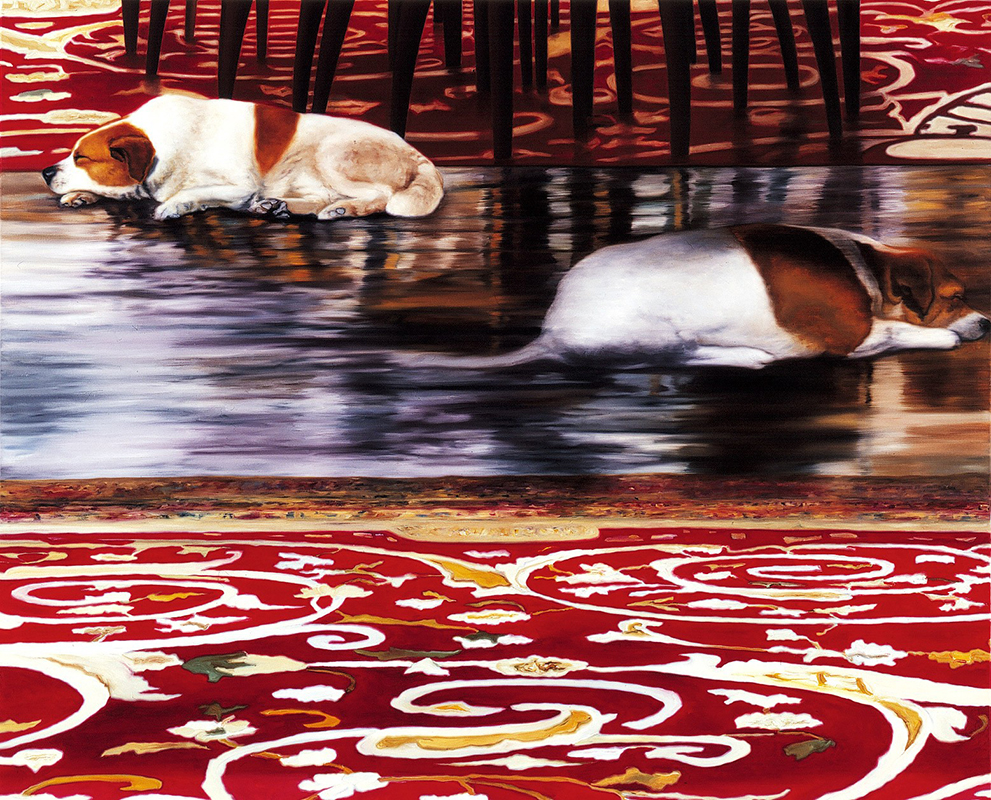
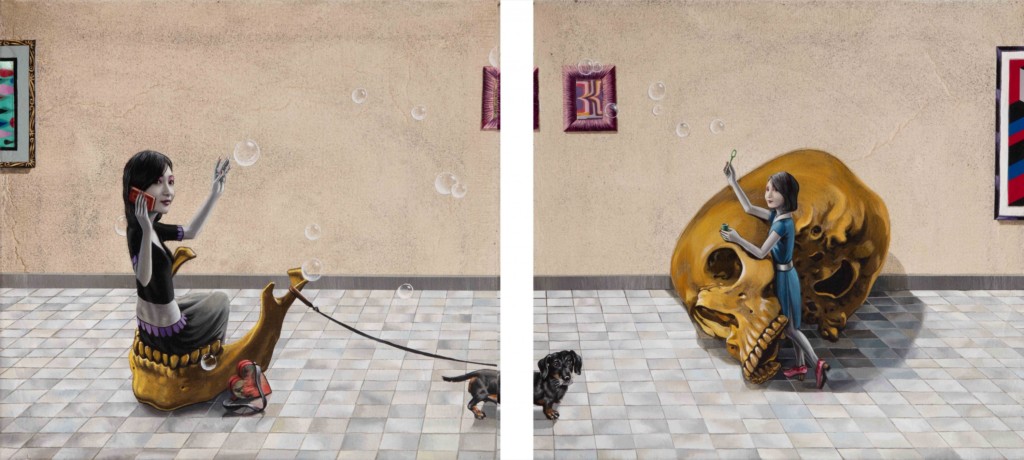
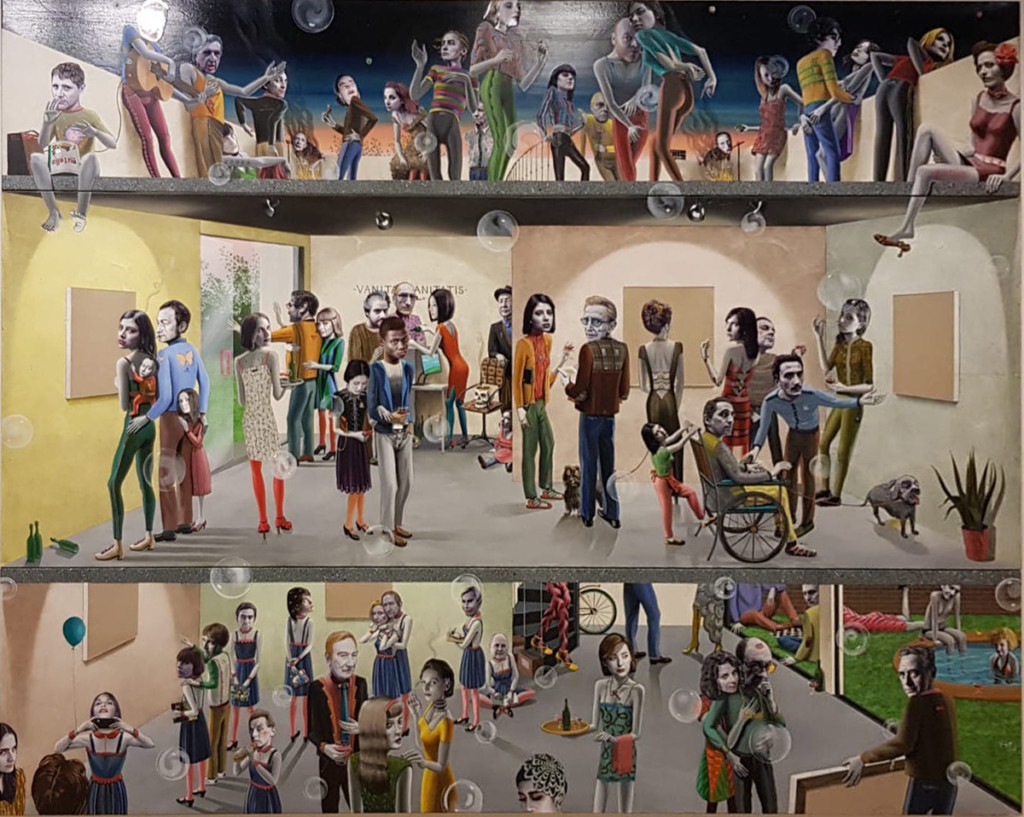
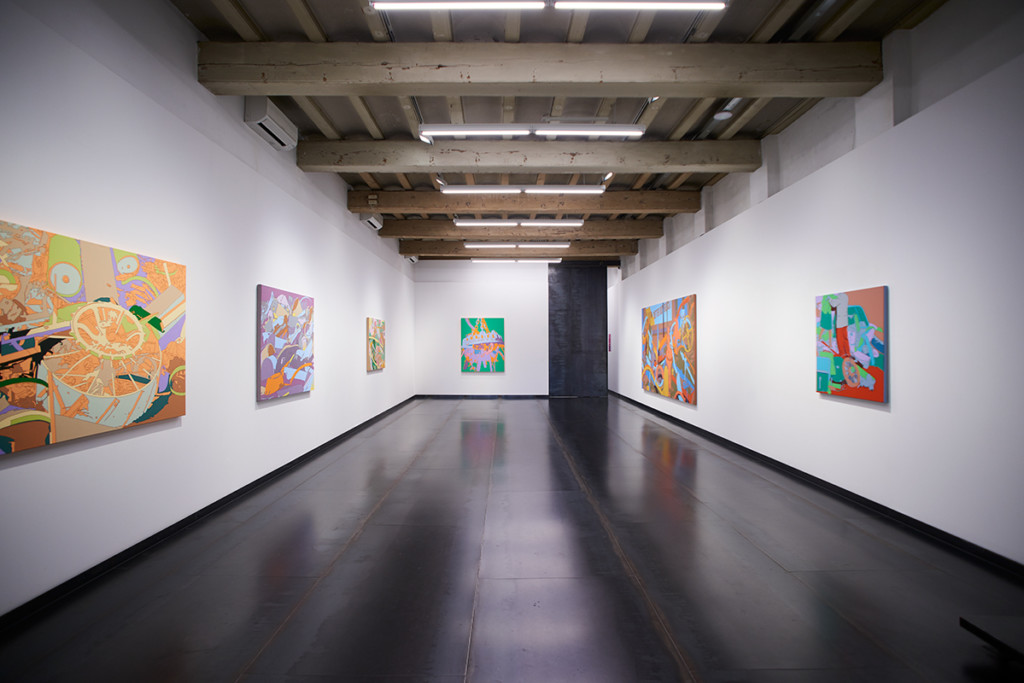
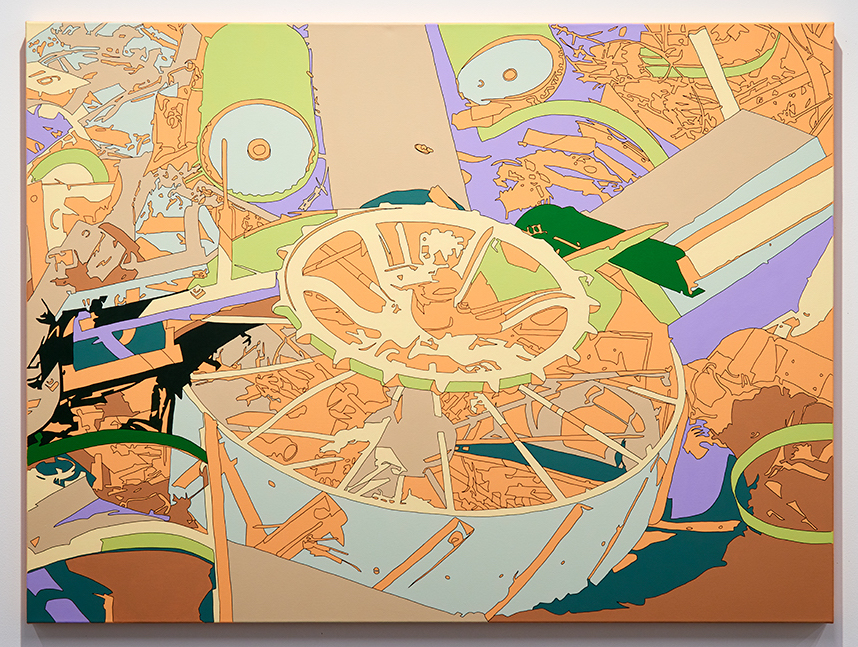
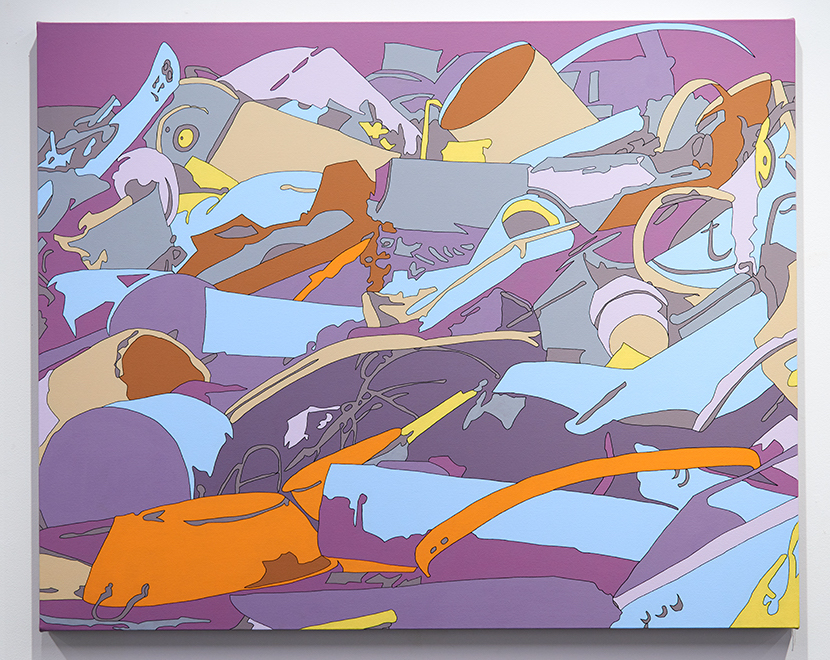
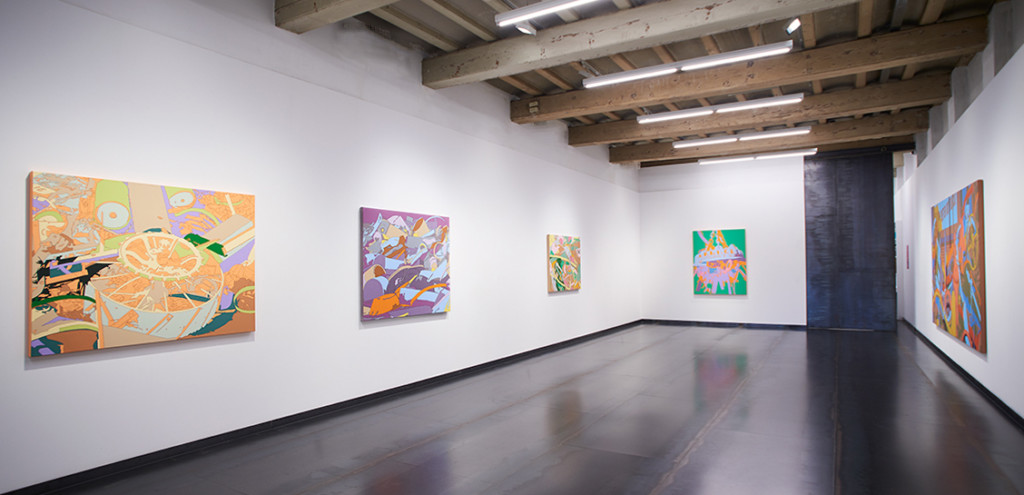
In this new series of large-format paintings, Gino Rubert portrays the world of art: its places, actors and events. The artist in society and in intimacy. To do so, he uses the rhetoric of meta-painting (the painting inside the painting) and also images where we see art galleries full of people attending an inauguration and other empty galleries that only have pictures resting on the floor and facing the wall. On the one hand, from the series The place to be, he talks about social life, glamour and shows business through baroque references such as the variegated horror vacui or symbols typical of Vanitas such as the skull or the soap bubble. On the other hand, the series To be or not to be reflects on the silence, solitude, and vertigo that invades the artist before the leap into the void that represents the night of the premiere.


“Even if we are not, are we? If no one looks at us, do we exist?” Gino Rubert


As an introduction to the exhibition in which light, colour, and drawing prevail over conceptual drifts, we find a large-format painting that presents the interior of an empty art gallery. In front of it, hundreds of photos and documents archived according to a precise but indecipherable criterion, more reminiscent of the secret record of an obsessive scientist than the photographic archive of an artist. With this scenic installation, Gino Rubert invites us to put ourselves in his place for a moment to understand his work process: “…I usually begin the paintings by spreading out photographic portraits on the canvas (some that I buy in flea markets, others that I have downloaded from the internet or, the most, that I have taken myself). And so, between those characters and myself, we are configuring a scene without previous ideas in such a way that finally the chemistry between those characters/souls and a point of scene direction on my part would be the ingredients of a cake that a priori I never know what form it will have or what it will taste like…”.

Following the trail of previous experimentations on collage and trompe l’oeil such as the use of natural hair in his exhibition Irma Lentamente (2009) or the introduction of text in Exvoto (2014), in the present The place to be or not to be, Gino Rubert introduces lighting on the back of some paintings in order to achieve a greater illusion of depth. As the artist says: “…I have always been particularly interested in that original ambition-function of painting to create the illusion of space; the process of translating with tricks, laws, and ingenuity, the world we perceive in three dimensions to the two-dimensional plane on which we draw…”.

Parallel to the exhibition, we will celebrate the publication of  Sí, quiero edited by Lunwerg and which presents an unusual and exciting portrait of sentimental relationships, with a series of events such as the presentation of the book and a round table.

MIRALDA -Soldats Soldés-

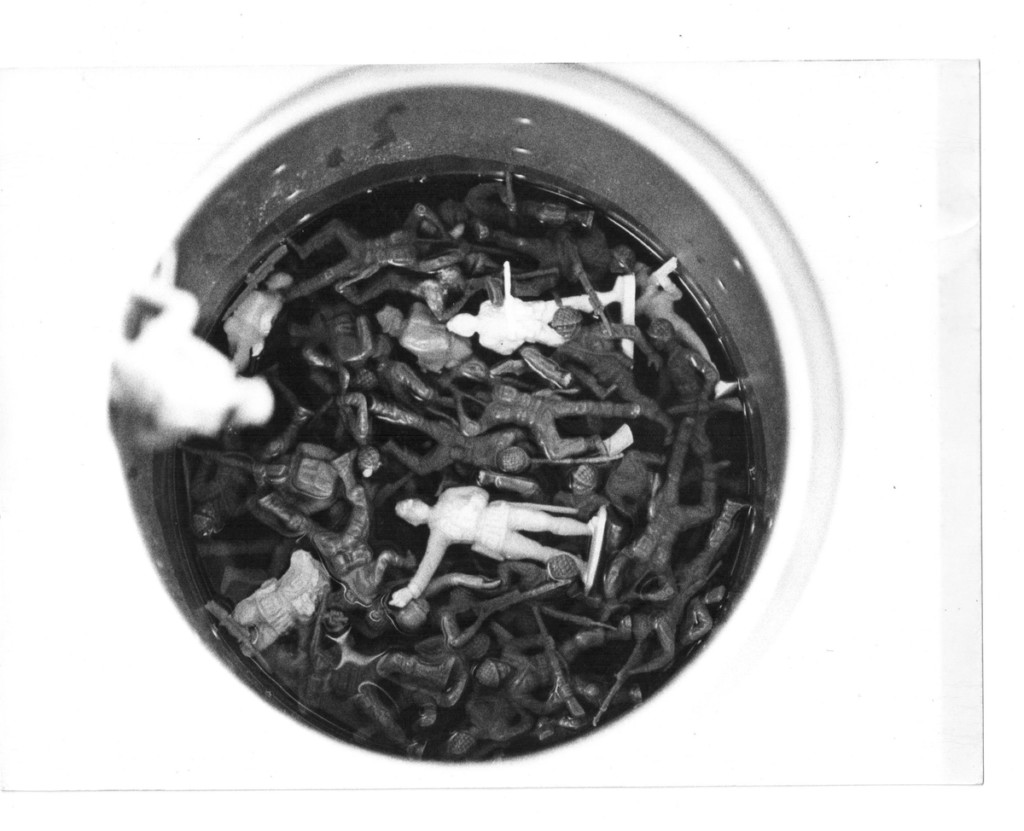
After more than 40 years hidden in his studio, MIRALDA brings out for the first time a group photographs of the famous series Soldats Soldés. This composition, all vintage copies, were taken by Miralda in Paris revealed in black and white between the years 1965 and 1970.

The series commonly know as Soldiers, is probably, the one who helped the most to get know to Miralda in the international scene, the toy soldier, accumulated over collages or inserted in found elements such as furniture, sculptures or public monuments, constitutes the first approximation to the ideas of seriality and files. This series is being widely exhibited on museums and institutions and is part of important collections such as ARTIUM, Fonds National d’Art Contemporain, Ministère de la Culture et de la Francophonie, París – Armario, Colección Sylvio Perlstein, Amberes Armoire de Toilette, Colección Musée Cantini, Marsella, Fundación La Caixa, Barcelona, IVAM, Valencia, Museo Nacional Centro de Arte Reina Sofía, Madrid y MACBA Barcelona.

Together with Galeria Senda, Miralda has decided to celebrate the recent award Velázquez de Artes Plásticas 2018 through this individual presentation in Arco hat forms an anti-war plea and documents critical actions with the political situations of that time.

In the main session (booth 9F08) we will be presenting new pieces by our artists  AES+F, Stephan Balkenhol, José Pedro Croft, Peter Halley, Ola Kolehmainen, Miralda, Túlio Pinto, Jaume Plensa, Aitor Ortiz and Glenda León.


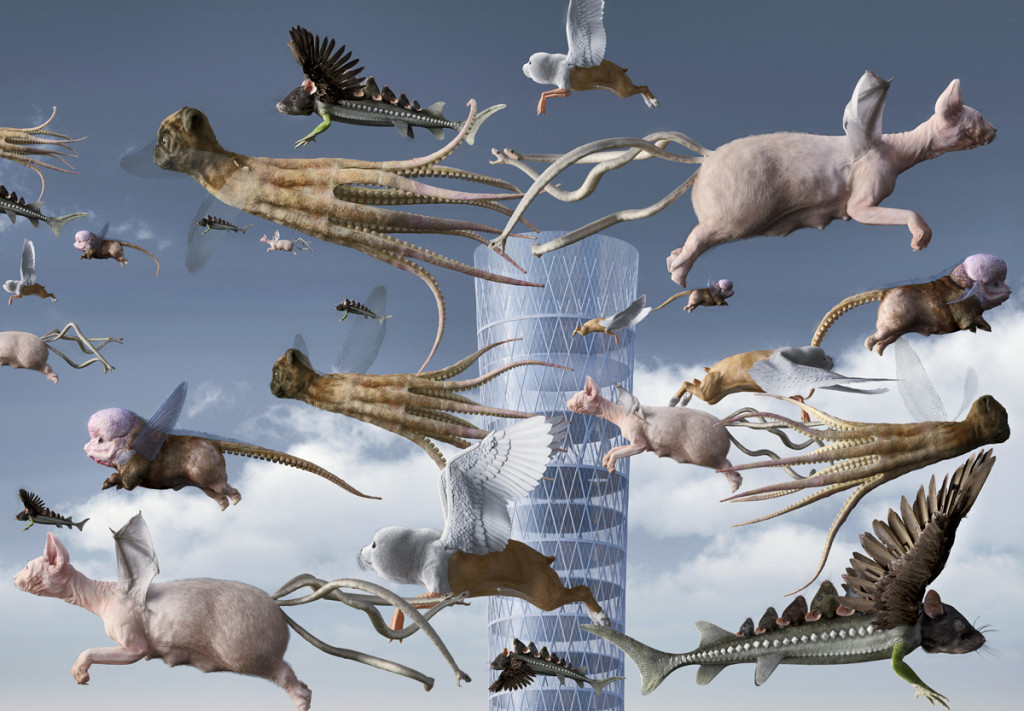
AES+F, Mare Mediterraneum

The Mediterranean Sea is the reservoir of civilization – its heart has pumped people, cultures, and religions from shore to shore like blood. The Phoenicians and Carthaginians flowed north, the Romans and Crusaders south, the Genoese east, Byzantines west, the Islamic Caliphates east, west, north, and south. Sicily is right in the middle and the waves of storms of all civilizations have splashed on her shores. This is still happening today.

The Mediterranean Sea is once again the epicenter of ideological contradiction. War has pushed refugees and migrants who, saving themselves, have floated and swum across it to confront Europe with a difficult choice. (In ancient myth Europa herself was also forced to cross this sea). Their choice has already led to politically charged and ideological confrontations, to the polarization of public opinion and to the rise of xenophobia and ethnic violence.

This tragic situation has become a political conflict as well as the subject of negotiation and ideological speculation. In this form, it has been transmitted by media as a meme in what is now described as ‘post-truth’. The ethical situation that has unfolded out of this is paradoxical, to say the least.

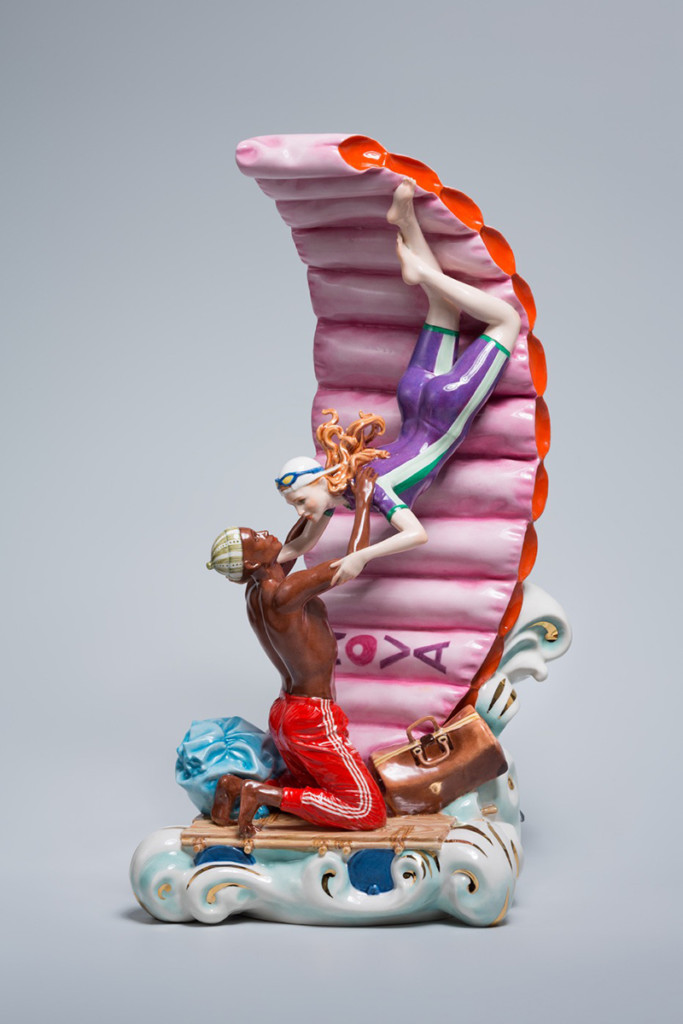
Making porcelain figurines on this subject could be thought an extreme manifestation of this paradox yet, through its distance, an artistic image may be more radical than reality itself because it can push conceptual limits.

Porcelain has always been a symbol of contentment and bourgeois comfort. The recent waves of migrations have confronted Europe with a dilemma: whether to accept refugees – allowing them to enter at the cost of the material and psychological comfort of their hosts; or to reject them in an immoral, inhumane, and cynical act that would undermine the co-operative ethical basis of Europe itself.

Comfort is both fallible and fragile, like the porcelain that is associated with it. Kept safe for generations in high places, porcelain figurines are attentively guarded but their fragility encapsulates the threat of instantaneous loss. They shatter easily.

The chosen form and material of these works contrast with the drama of what is unfolding in the Mediterranean today, and, by doing so, point to it. A reflected ray of light illuminates better than a direct one. We think that this holds true concerning this work.

Edited by David Elliott

Mare Mediterraneum

The Mediterranean — a territory where, in significant part, modern human civilization was born, with its culture and three most prevalent religions.
From the Roman Empire to the Arab caliphate, to the colonial wars and now the European Union, the territory around the Mediterranean Sea at times formed one culture and government, and at times split in bloody religious and territorial conflict.

Now we are once again living in an epoch of global change — cultural, demographic, political, and economic. The Mediterranean, like in the past, is in the epicenter of these events. We are once again seeing mass migration of people, armed conflicts, but also brilliant displays of humanity and empathy.

The project consists from the series of 9 porcelain figurines, colorfully painted in the tradition of 18th century European porcelain, and a multimedia installation (for exhibitions), depicting various states of the sea — calm or storm.

Túlio Pinto, 41° 23′ 20” N 2° 10′ 34’’ E and 41° 25′ 21” N 2° 12′ 32’’ E: Three Times

The exhibition “41° 23′ 20” N 2° 10′ 34’’ E and 41° 25′ 21” N 2° 12′ 32’’ E: Three Times” by Túlio Pinto is the fruit of an intense artistic relationship he established in Barcelona during the four months he spent in the Catalan capital.

The project will be divided into three exhibitions in different galleries and periods of time. His first two exhibitions will be shown between LAB 36 of galeria SENDA and the Piramidón, Centre d’Art Contemporani.

At the Piramidon, where he made an art residence program in the summer of 2018, will be presented a sculptural installation that remits to spatial drawing concept. At the same time, at LAB 36 of galeria SENDA will expose the video Unicórnio which encompasses one of the recurring themes in his investigation, the impermanence in the sculptural language, as well as, sculptures in iron and blowing glass. The third exhibition of the project will take place at galeria SENDA, during the summer of 2019 with the presentation of a big scale installation created for the architectonic space of the gallery.

Túlio Pinto develops his artistic research through the force of opposites, generating tensions that challenge the physical laws as gravity while remaining in perfect balance. This harmony is achieved through the perfect weighting of the masses, volume and density of materials of opposite natures and behaviours such as cement, iron, rock, glass, plastic and water.


“This is how he feels and translates the pulsation of the world of things to be reflected (also) in the world of human relations. An ambiguous game, which, in a first reading may seem circumscribed to the formal combinations that were born from the Brazilian constructivist inheritance or the international minimalism. A second analysis, though, brings the perception that, beyond tradition (which the artist makes reference to and competently and rigorously expands), there is a consistent authorial poetics, which subverts the already established. It indicates urgencies that remain current: the shifting and utopic territory of harmony among opposition”.

Angélica de Moraes (Conjugação de Forças, 2016)


The architectural space is closely related to the development of his installations. Pinto takes advantage of the space and appropriates the elements that constitute it. “I am much more a transmission vehicle than a traditional sculptor as I increase in a new impulse the forces present in the objects, putting in evidence these approximations an/or cancellations that are generated” as the artist explain.


TÚLIO PINTO                                                         

Born in Brasilia, Brasil in 1974.

Formed in Fine Arts focused in sculpture at the Federal University of Rio Grande do Sul in 2009. Among his main exhibitions we can emphasise Nova Escultura Brasileira at La Caixa Cultura RJ in 2011, Brasil; Ground at Baró gallery in 2013, Brasil; The Vancouver Biennale in 2014, Canada; Onloaded at Phoenix Institute of Contemporary Art in 2015, United States; among others.

His work is part of public collections as:

Institute Figueiredo Ferraz (Ribeirão Preto, Brasil); Ca.Sa Collection (Santiago – Chile); Phoenix Collection (Phoenix, Arizona-USA); Contemporary Museum of Paraná (Curitiba, Brasil); Cultural Foundation Itajaí (Itajaí, Brasil); Contemporary Museum of Rio Grande do Sul (Porto Alegre, Brasil); National Museum of Brasilia (Brasilia, Brasil); Museum of Art of Ribeirão Preto (Ribeirão Preto, Brasil); Municipal Pinacoteca Aldo Locatelli (Porto Alegre, Brasil).


Túlio Pinto, Unicórnio, 2015 video 9´51”, Superstition Mountains, Phoenix, Arizona, USA

MIGUEL ANGEL RÍOS, Landlocked

In his work, Miguel Angel Ríos pairs a rigorous conceptual approach with a meticulously constructed, often handmade aesthetic. Since the 1970s, he has made work about the concept of the “Latin American,” using this idea as both an artistic strategy and a political problem. Since the early-2000s, Ríos has also delved into the medium of video to create symbolic narratives about human experience, violence, and mortality.

LANDLOCKED: Bolivia has suffered since several centuries access block to the Pacific Ocean. The video Landlocked is a Metaphor of desire of the unreachable. Dogs of the high mountains from the Andes foothills, were trained to dig and execute their work, creating an illusion to get to the Ocean.

MIRALDA. Three Projects (NYC-MIA-BCN)

The exhibition MIRALDA THREE PROJECTS (NYC-MIA-BCN) will present original works, records and documentary archives of The Last Ingredients (MIA), Apocalypsis Lamb (NY-BCN) and Santa Eulalia. 175 (BCN).

The Last Ingredients was a performance of a procession of vehicles and a public feast in Miami in 2016, which celebrated the opening of the Faena Forum Art Center of Rem Koolhaas. The Bedspread Apocalypsis Lamb was part of the Honeymoon project in which an imaginary wedding between the Statue of Liberty of NY and the Columbus Monument of Barcelona was held; In 1989 the Bedspread took part in the Columbus Day tour in New York City and in 1995 hundreds of people carried it to the MNAC where was raised and in which it remains as part of the permanent collection. Finally, Santa Eulalia. 175 consisted of a performance with a procession of 80 musicians and 150 banners, as well as a series of festive events on the occasion of the 175th anniversary of Santa Eulalia store in 2018.

Photos, drawings, videos, objects, collages, etc., will be shown as record material and this will allow the viewer to get an idea of the scope and complexity of each of these works with the public intervention of participatory and processional character and that characterizes the artist.


Glenda León “Talking to God”

The calming chants submerged the Baroque church interior with an expression both of reverence and withheld tension. Its worshippers sat in pews, bathed in ethereal glow. With eyes cast down presumably in prayer, the video soon reveals the worshippers’ preoccupancy with the cellphone, a tool that occupies most part of our lives. As the chant changes in dynamics, one may not discern the technological alteration of a bat’s call— mimicking human tonality. As a nocturnal animal, the bat is associated with the Devil in Western culture. The video transitions to an omniscient perspective, with a collective of screens appearing like a constellation of stars.

“Talking to God” hones on the misplacement of technology as a contemporary phenomenon, and the desacralization and decentralization of what is canon. Through representation as a substitute of the real, it shows a group of alienated individuals, in silent bearings of devotion to the unknown. While the environment of a Catholic church suggest an intimate conversation with a Higher Self, or an exaltation of the Faith, the fact that people are absorbed in their cell phones raises a reflection on the role that technologies play in our current lives. Can we update the Faith?

Seldom, as in these times of Internet, we have had the possibility of reaching absolute knowledge and exercising the power of omnipresence. Never before was the human being so close to resembling God, and yet the essential seems to move further and further away. The beauty of the final frame, a distant shot similar to a starry sky, leaves us a possible, optimistic exit, where both elements, the technological and the spiritual, come into harmony.